
Settled international competition for the UAMD Durrës campus, Albania.
Masterplan
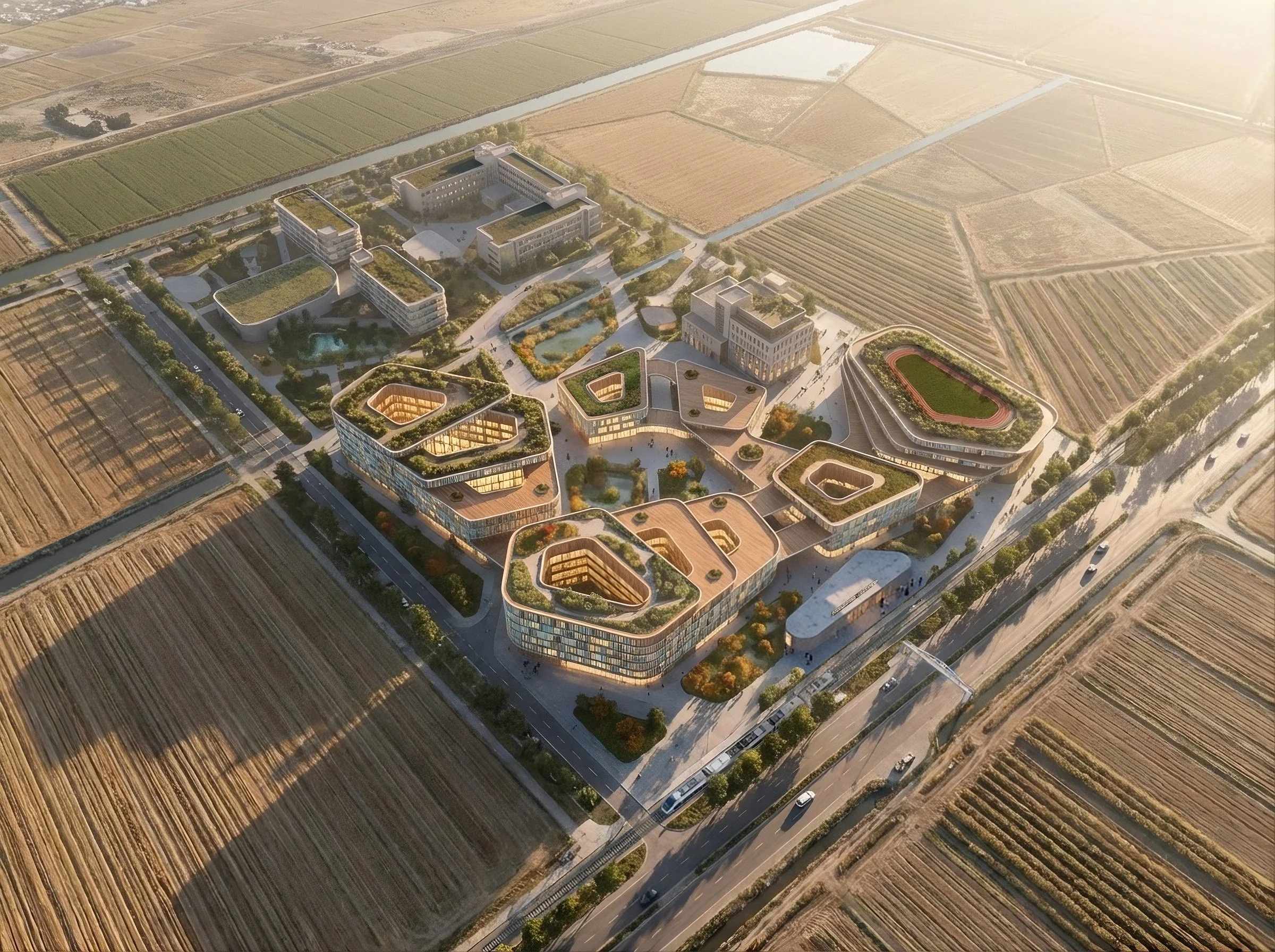
STRATA masterplan is conceived as a three-dimensional living landscape where water, vegetation, soft mobility, and architecture operate as a unified ecological system. Developed in collaboration with landscape architects, urban thinkers, local designers, and in partnership with the artists PichiAvo, the campus emerges as a climate-responsive territory rather than a conventional collection of buildings.
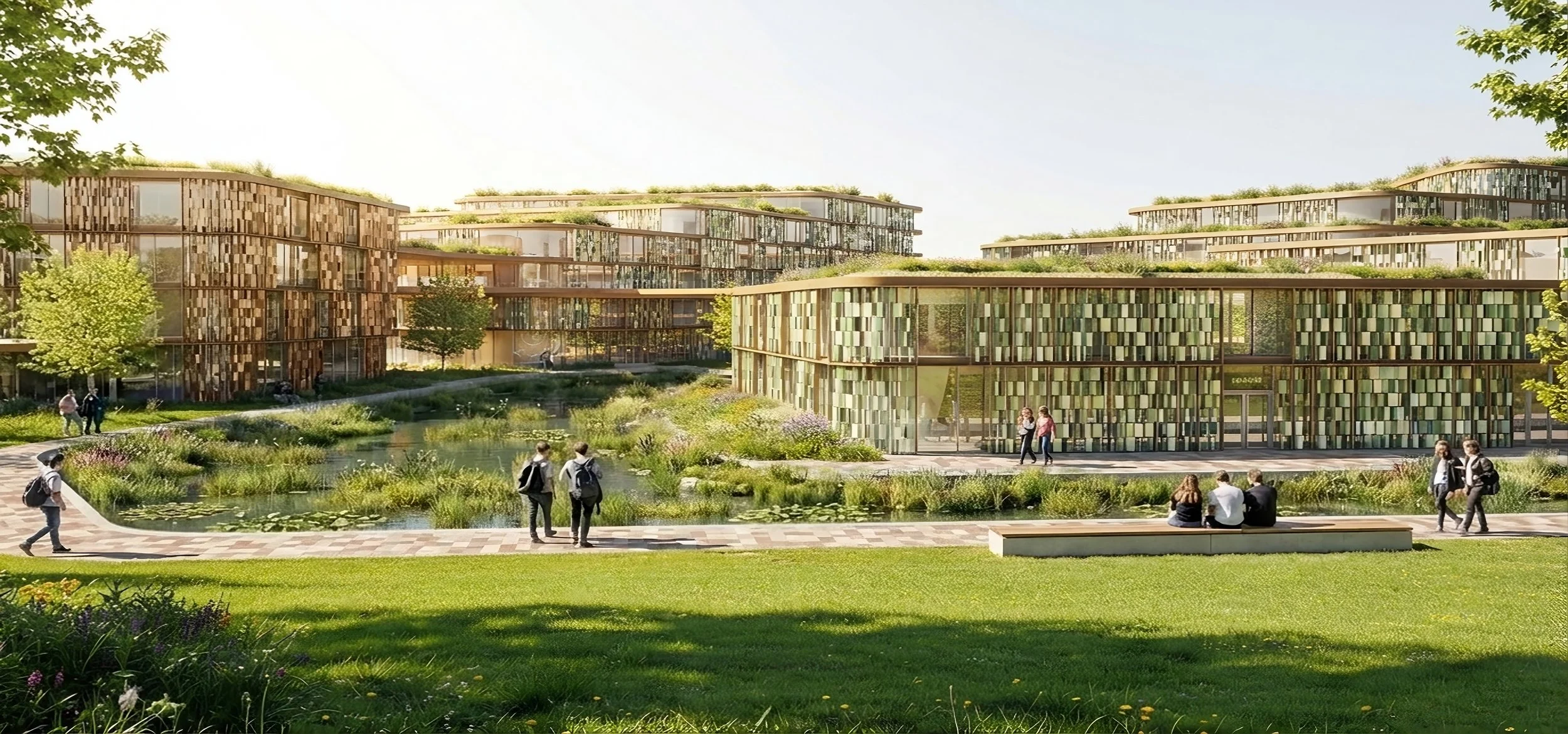
At the territorial scale, the project integrates the existing canal network, the future railway line, and the new train station as structuring frameworks. Water is conceived as active climate infrastructure: wetlands expand in winter to absorb and regulate rainfall, preventing flooding, and contract in drier seasons while cooling public space and shaping microclimates. Vegetation forms a continuous canopy and a seasonal mosaic of chromatic “pixels,” reinforcing biodiversity and defining outdoor learning and social environments. Buildings evolve from closed volumes into inhabited platforms, lightly embedded within this ecological matrix.
Their arrangement generates shaded courtyards, open-air classrooms, and a sequence of public spaces connected by bridges, wooden decks, and gently sloped promenades. Mobility is treated as landscape: pedestrian and cycling networks flow seamlessly through water, terrain, and architecture, dissolving rigid hierarchies in favor of an integrated, human-centered system.
Cultural activation is embedded within this framework. PichiAvo’s reinterpretations of classical divinities—symbols of knowledge, wisdom, justice, and coexistence—act as contemporary landmarks, reinforcing the campus as a cultural bridge between heritage and present expression.
Vehicular access is limited to the perimeter and underground parking, ensuring a fully pedestrian and bike-oriented core. The cycling network extends into the buildings themselves, with parking integrated under canopies and within the architecture, including dormitories equipped with large elevators to accommodate bicycles.
Open-air gathering areas, outdoor study zones, riparian gardens, and shaded platforms form a continuous spatial network where learning, leisure, and movement converge. The masterplan ultimately proposes a new academic landscape: a climate-adaptive, culturally layered, soft-mobility ecosystem in which architecture becomes the gentle residue of a resilient blue–green infrastructure.